What Is POF Shrink Film? Five-Layer Coextrusion
POF shrink film is a polyolefin film used for high-speed packaging. How coextrusion works, what shrink rate means, and how to select film for a packaging line.
PSF Packaging Engineering · Published November 3, 2026 · Updated November 20, 2026 · 3 min read
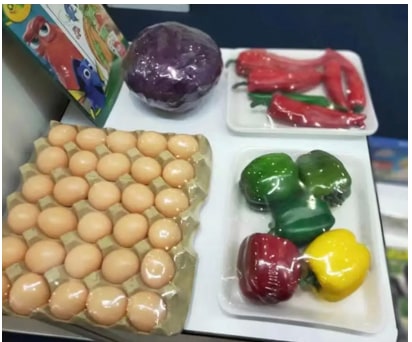
POF (polyolefin) shrink film is a biaxially oriented polyolefin film that contracts when heated, tightening around a product to form a tamper-evident, transparent wrap. PSF Packaging supplies five-layer coextruded POF film with a shrink rate of 50% or more, qualified on high-speed lines with 7–15 working day lead times.
Key points
- Five-layer coextrusion balances shrink force, optics, sealability and stiffness in one film.
- Shrink rate is directional — machine-direction and transverse-direction values must be specified separately.
- POF is a polyolefin, not PVC: it does not release chlorine when heat-shrunk.
- Film that shrinks well on one line can wrinkle on another — tunnel temperature and conveyor speed matter.
Definition
POF shrink film is made by extruding several polyolefin layers into a single film, then stretching it in both directions. The stretching aligns polymer chains and stores orientation energy. When the film is heated above its shrink activation temperature, the chains relax and the film contracts around the product.
The process is used for food, beverages, household goods and multipacks, where a tight transparent wrap provides protection and product visibility.
What the five layers do
| Layer position | Typical function | Effect on the line |
|---|---|---|
| Inner seal layer | Low-temperature heat sealing | Faster sealing, wider sealing window |
| Tie layer | Bonds incompatible polymers | Prevents delamination during shrink |
| Core layer | Stiffness and shrink force | Holds shape around irregular products |
| Outer skin | Optics and abrasion resistance | Clarity and scuff resistance in transit |
| Second skin | Blocking and slip control | Film unwinds cleanly at high speed |
Fewer layers mean more compromise: a two-layer film may shrink adequately but seal poorly at the speed the line requires.
Shrink rate is two numbers
Suppliers often quote a single shrink percentage. In practice the machine-direction (MD) and transverse-direction (TD) values differ, and the ratio determines whether a film suits a given product shape.
| Product shape | MD / TD requirement | Failure mode if mismatched |
|---|---|---|
| Cylindrical bottles | Higher TD shrink | Dog-ears at the top and bottom |
| Rectangular boxes | Balanced MD and TD | Wrinkles at corners |
| Trays with product protruding | High TD, controlled MD | Film bridges over the tray |
| Multipacks | Low shrink force | Product deformation or crushing |
PSF supplies POF with 50%+ shrink rate; the MD/TD balance is confirmed against the customer’s line and product before production.
Running a line trial
A film is only qualified on the actual machine. A practical trial records:
| Parameter | What to record | Why |
|---|---|---|
| Tunnel temperature | Setpoint and measured profile | Uneven heat causes wrinkles |
| Conveyor speed | Metres per minute | Faster speeds need more heat |
| Seal temperature and dwell | Temperature, time, pressure | Seal failure is a top complaint |
| Shrink appearance | Wrinkles, dog-ears, clarity | Visual acceptance criterion |
| Reject rate | Bags rejected per 1,000 | Commercial qualification metric |
Boundary: where POF is the wrong film
POF is not a high-barrier film. It does not replace aluminium foil or metallised structures for products sensitive to oxygen or light. It also does not provide the rigid presentation of a printed carton. Where a product needs extended shelf life or premium shelf presence, POF is usually the outer tamper band over a primary package — not the primary package itself.
For food-contact statements, see food contact packaging compliance; the resin, ink and contact conditions all have to match the destination market.
This article describes general practice in flexible packaging. It is not a substitute for a specification review of your product — film structure, functional values and compliance depend on the contents, the packing line and the destination market.