Flexible Packaging Glossary
Twenty terms that decide whether a bag gets specified correctly. Each entry gives the definition first, then the practical consequence that the definition implies.
Most packaging disputes trace back to a term being used with two meanings — a shielding bag assumed to block static when it only avoids charging itself, a shrink rate quoted on a datasheet but not on the line, a "food-safe" claim without the food-grade structure specified. These definitions remove that ambiguity: each states what the term means and what it does not mean.
1
- 150 LPI — Lines per inch / 网线数
-
A halftone screen ruling of 150 lines per inch, describing how many rows of dots per inch are used to reproduce continuous-tone images in printing.
PSF runs offset and gravure processes at 150 LPI (胶版+铜版双工艺). A higher ruling gives finer detail but tolerates less dot gain and needs a smoother substrate; on matte CPE film the shadow dots can fill in unless plate and ink are matched to the surface. The print process is therefore chosen together with the film, not after it.
B
- Bubble bag — 气泡袋
-
A cushioning pouch made from film embossed with air-filled bubbles and sealed into a sleeve around the product.
Bubble cushioning protects against impact but adds thickness, which can push a parcel into a higher volumetric-weight band. For flat, robust items a thin EPE or paper sleeve gives adequate protection at lower shipping weight; the bubble structure earns its cost on fragile or irregular shapes where direct contact would cause damage.
C
- CPE — Cast polyethylene / 流延聚乙烯
-
Polyethylene film made by casting the melt onto a chilled roll instead of blowing a bubble, giving high clarity, a soft hand and consistent gauge.
CPE is the base of the matte bags added in the 2017 expansion. Cast film has little molecular orientation, so it is selected for feel and print appearance rather than puncture resistance; a bag for sharp contents is safer in a blown structure. Gauge consistency also makes CPE predictable in high-speed heat sealing.
- Card head bag — 卡头袋
-
A bag with an extended, reinforced header through which a hanger hole is punched so the packed product can be displayed on a retail hook.
The header carries the hanging load, so a card head bag fails at the punched hole long before the body fails if the film is too thin there. The header is normally a doubled or laminated strip; punching it in the same operation as the body keeps the hole centred and avoids tear-out that only appears once the bag is on a hook.
E
- ESD shielding — 防静电屏蔽
-
A packaging structure, normally a laminate containing a conductive or dissipative layer, that attenuates external electrostatic fields and limits charge buildup around sensitive electronics.
A shielding bag needs a continuous metallised layer; a translucent pink anti-static film only prevents the bag itself from charging and does not block an external field. Specifying on appearance alone therefore leaves circuit boards exposed. PSF added anti-static and ESD shielding bags in the 2017 equipment expansion, and the shielding structure is chosen by the sensitivity of the device inside rather than by bag thickness.
- EPE foam — 珍珠棉 / expanded polyethylene foam
-
Expanded polyethylene foam, a closed-cell cushioning material with independent air cells that recover after repeated compression.
EPE absorbs shock; it is not a barrier film and is not heat-sealed like one. Because its cells are closed it does not take up water, which suits electronics packed alongside desiccants. It is cut and assembled as a separate operation from bag converting, so adding an EPE insert changes both the packing step and the finished carton dimensions.
F
- Food contact material — 食品接触材料
-
A material intended to come into contact with food, subject to the migration limits and compositional rules of the market in which the food is sold.
Compliance applies to the finished article, not only to the base resin — printing ink, adhesive and additives must meet the same rules. PSF supports its food-contact claim with FDA 21 CFR 177.1520 for polyolefin film; confirm the destination market before quoting, because an FDA-compliant film is not automatically accepted in the EU.
- FDA 21 CFR 177.1520
-
A United States regulation that lists the olefin polymers permitted in food-contact articles and sets limits on their composition.
The regulation governs the polymer rather than the finished bag, so it has to be read together with the ink, adhesive and additive requirements for the specific food type. Certificate number and validity are not published by PSF; request the document during supplier onboarding instead of treating the standard reference alone as verification.
G
- Gravure printing — 凹版印刷 / 铜版印刷
-
A printing process in which the image is engraved as cells in a cylinder, with ink metered by a doctor blade and transferred to the substrate under pressure.
Gravure holds consistent density over long runs and becomes economical once the engraved cylinder cost is spread across sufficient volume. On short runs that cylinder cost dominates, which is why PSF keeps offset alongside gravure: the process follows the order quantity rather than forcing every job through the same press.
H
- Heat seal — 热封
-
A joining process in which two thermoplastic layers are heated and pressed until their interfaces soften and fuse into a single continuous layer.
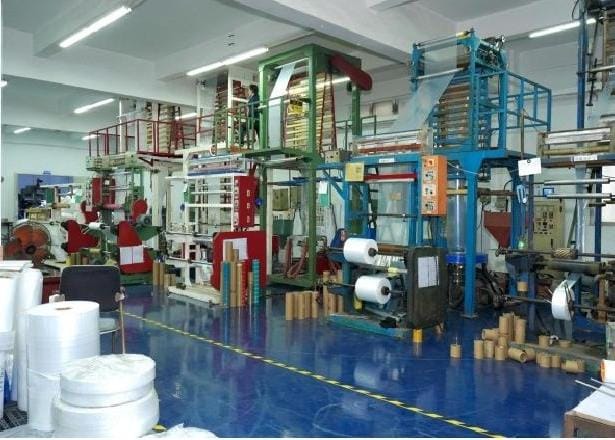
Seal strength depends on temperature, dwell time and pressure, and all three must be reset when the film structure changes — settings tuned for CPE will burn through a thinner PE film. The bag-converting line forms heat seals, zipper closures and shaped bags; seal failure usually appears as a channel leak at the jaw edge, which is why peel testing is run on the production setting rather than on a hand-made sample.
M
- mPE — Metallocene polyethylene / 茂金属聚乙烯
-
Polyethylene polymerised with a metallocene catalyst, producing a narrower molecular-weight distribution and more consistent sealing behaviour than conventional low-density polyethylene.
mPE seals at a lower temperature and holds stronger hot-tack, so a bag-making line can run faster without seals opening under the weight of the contents. It earns its cost mainly as the sealing layer of a multilayer structure; using it as the only layer wastes the property gain where it is not needed.
O
- OPP — Oriented polypropylene / 定向聚丙烯
-
Polypropylene film stretched after extrusion to align its molecules, raising stiffness, clarity and moisture barrier along the stretch directions.
OPP is stiff and prints sharply, which is why it is used for the self-adhesive bags introduced in 2017. The trade-off is that oriented film splits along the machine direction once a notch starts, so a bag meant to be opened and closed repeatedly by hand is usually made in CPE or PE instead.
- Offset printing — 胶版印刷 / 平版印刷
-
A planographic printing process in which ink passes from a plate to a rubber blanket and then to the substrate, without the plate contacting the substrate directly.
Offset avoids the cylinder cost of gravure and suits shorter runs, but the blanket transfer loses a little fine detail and needs a substrate that accepts ink without spreading. PSF added offset presses in 2017 and runs them at 150 LPI; for fine type or small halftones the substrate and the process are chosen as one decision.
P
- POF shrink film — POF 收缩膜
-
Polyolefin shrink film, a coextruded multilayer film that contracts tightly around a product when heated above its activation temperature.
PSF developed POF shrink film in 2019–2020. It is selected over PVC shrink film where food contact or material compatibility matters, because polyolefin avoids the plasticiser and chlorine-containing by-products associated with PVC. The shrink window is narrow: too little heat leaves loose corners, too much distorts the print or the product underneath.
- PLA biodegradable bag — 聚乳酸可降解袋
-
A bag made from polylactic acid, a polymer derived from renewable feedstock that can biodegrade under controlled industrial composting conditions.
PSF launched PLA biodegradable bags in 2022–2023. "Biodegradable" is conditional: most PLA films need an industrial composting environment and will not break down in a home compost bin or in soil within a normal product life. Agree the disposal route at the design stage, because a PLA bag entering a conventional recycling stream contaminates the PET fraction.
R
- REACH
-
The European Union regulation on the registration, evaluation, authorisation and restriction of chemicals, covering substances contained in articles placed on the EU market.
REACH compliance is a materials-declaration exercise, not a factory accreditation. PSF completed its EU REACH work in 2022–2023. What a buyer should request is a declaration of the relevant substances in film, ink and adhesive; the phrase "REACH certified" on its own does not identify what was assessed.
S
- Surface resistance — 表面电阻
-
The resistance measured across a material surface, expressed in ohms per square, used to classify a film as conductive, static-dissipative or insulative.
Surface resistance decides whether a bag merely avoids charging itself or can also drain charge from a device that touches it. An insulative film holds charge and can deliver a discharge through a component lead; a dissipative surface provides a controlled path to ground. Specify the humidity at measurement, because surface resistance shifts with moisture and a value recorded in a dry room will not describe a humid warehouse.
- Shrink rate — 收缩率
-
The percentage by which a shrink film contracts in the machine direction and in the transverse direction when exposed to its activation temperature.
Shrink rate is measured in each direction separately, and the two values are rarely equal. A film with high transverse shrink and low machine-direction shrink will tighten around a cylindrical item but leave slack along a rectangular box. Choose the film against the product geometry and confirm the actual tunnel temperature on the line, not just the number on the datasheet.
V
- VCI — Volatile Corrosion Inhibitor / 气相防锈
-
An additive that releases a corrosion-inhibiting vapour from a carrier film or paper, protecting metal surfaces enclosed inside a package.
VCI protects only in a sealed enclosure: the vapour has to reach saturation around the metal, so a vented or loosely closed bag removes the protection completely. It addresses corrosion, not static, and does not replace an ESD shielding layer for electronic hardware with exposed contacts. The two measures solve different failure modes and are often specified together.
Z
- Zipper bag — 骨袋 / reclosable bag
-
A reclosable bag whose opening is formed by interlocking male and female profiles that can be separated and rejoined repeatedly.
The zipper is a separate component welded into the bag mouth, so the ends of the profile are the usual failure point — a bag that leaks at the corners generally has an under-welded zipper end rather than a faulty closure. PSF zipper bags are shown in the product photos; the closure is specified by the number of open-close cycles the application needs, not by film thickness alone.
Compliance references follow ISO 9001, EU REACH and FDA 21 CFR 177.1520 where those regimes apply. Where industry usage differs from the formal definition, the practical usage is noted in the detail paragraph. Certificate numbers and validity are not published by PSF and should be requested during supplier onboarding.
Send your bag specification, get a quote
Give us the format, dimensions, film structure and artwork. You will receive an indicative price, a stated lead time and a clear answer on whether we can hold the specification — no obligation, and no sales call unless you ask for one.